What are the symptoms of genital herpes?
What genital herpes symptoms look like, how first and repeat outbreaks differ, what triggers them, and how herpes is treated and tested for.
- Published 1 November, 2026
- Medically reviewed
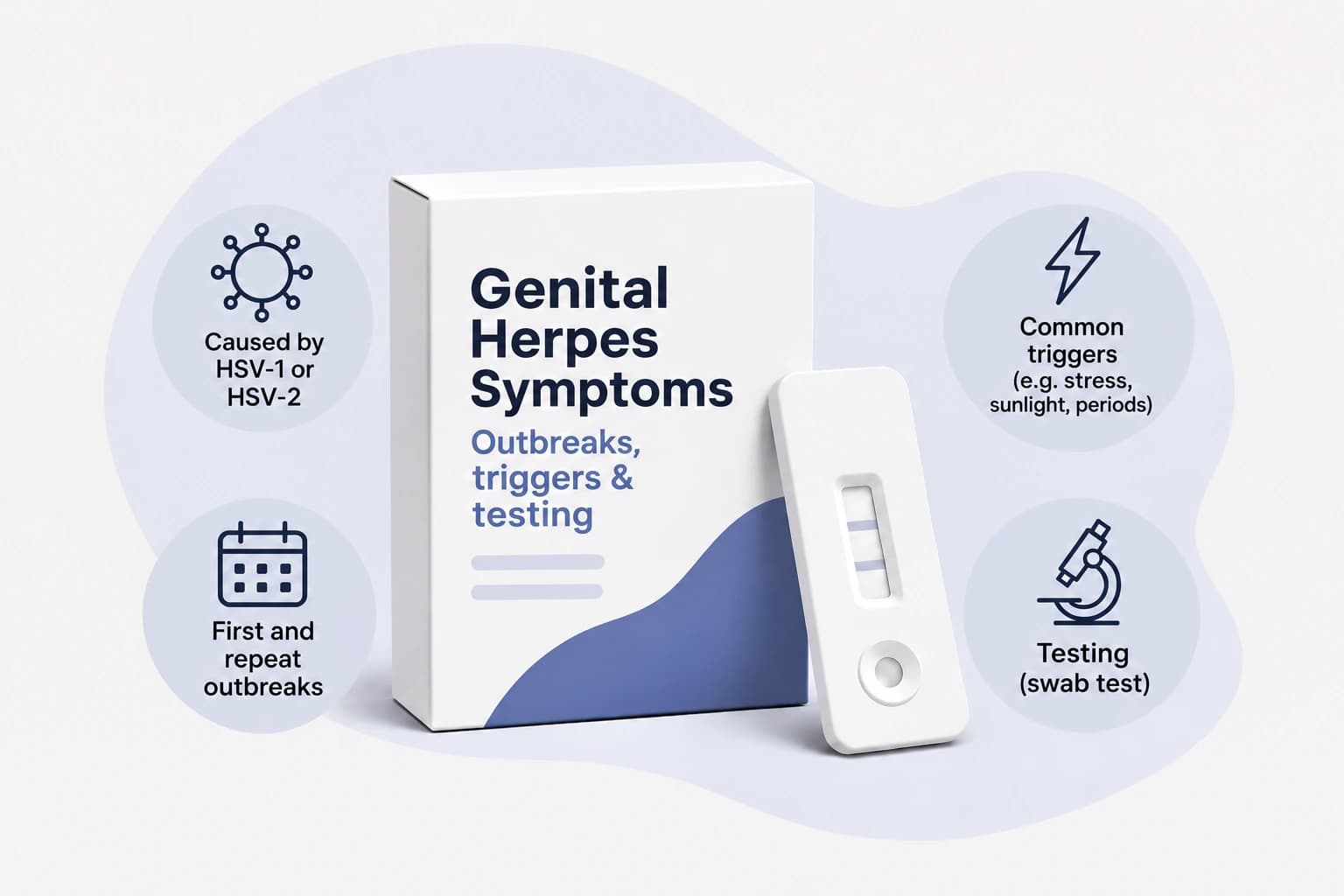
Genital herpes is a sexually transmitted infection (STI) caused by the herpes simplex virus (HSV). There are 2 types: HSV-1, which mainly causes cold sores but can be passed to the genitals through oral sex, and HSV-2, which almost always affects the genitals. It spreads through skin-to-skin contact during vaginal, anal or oral sex.
In England, sexual health services diagnosed 28,779 first episodes of genital herpes in 2025, up 3.1% on 2024.
Not everyone gets symptoms when they're first infected, so you can have herpes without knowing. When symptoms do appear, the first outbreak is usually the worst.
Key takeaways
- Genital herpes is caused by HSV-1 (the cold sore virus) or HSV-2, which almost always affects the genitals.
- Most people have no symptoms or very mild ones, so you can have herpes without knowing.
- A first outbreak is usually the worst and can cause blisters, sores and flu-like symptoms.
- Repeat outbreaks are usually milder, and a tingling or burning feeling can warn that one is starting.
- Sunlight, friction, stress and periods can trigger an outbreak.
- Herpes can be passed on without symptoms, but the risk becomes rare after 2 years.
- There's no cure, but outbreaks get milder over time and antivirals can help.
- If you have sores, a swab test at a sexual health clinic can confirm the cause.
What are the symptoms of a first genital herpes outbreak?
The main symptoms of a first genital herpes outbreak are small blisters that burst to leave red, open sores around the genitals, anus, thighs or bottom. Sores may look less red on brown or black skin.
A first outbreak can also cause any of the following:
- spots or red bumps around the genital area
- tingling, burning or itching around the genitals
- pain inside the vagina, at the head of the penis or around the anus
- unusual discharge
- pain when peeing, or not being able to pee
- a fever or high temperature
- flu-like symptoms, such as headache or backache
- mild swelling of the glands in the groin, armpits or neck
How long does a first genital herpes outbreak last?
A first outbreak of genital herpes can last 2 to 4 weeks. Symptoms usually appear 2 to 12 days after contact, though some people don't notice anything for months or even years.
If you think you're having a first outbreak, get seen quickly. Antiviral medicine needs to be started within 5 days of symptoms appearing to stop them getting worse. If it's been longer than that, you can still get tested to find out what's causing them.
What do recurrent genital herpes outbreaks look like?
Recurrent outbreaks usually cause similar blisters and sores to the first one, but they're usually milder and don't last as long.
Herpes can come back because there's no cure for genital herpes. Once you have the virus, it stays in your body, lying dormant in a nearby nerve. It doesn't spread to other parts of your body, which is why outbreaks tend to appear in the same area each time.
Over time, outbreaks tend to become less frequent and less severe, and some people never have another one.
Are there early warning signs of a herpes outbreak?
Yes. Before blisters appear, you may feel tingling, burning or itching where they're about to form. Some people also feel pain in their bottom, hips or legs.
It's worth learning to spot these signs. Herpes is very easy to pass on from the first tingle until the sores have healed, so avoid sex until then. It's also the best time to start antivirals if you take them.
What triggers a genital herpes outbreak?
Once you have herpes, the virus stays in your body. It can lie dormant for long periods without causing any symptoms, then reactivate and cause an outbreak in the same area as before. Certain things can trigger this, so it can help to avoid them where you can.
Triggers can include:
- UV light on the affected area (sunbathing or sunbeds)
- friction from sex or tight clothing (lubricant may help during sex)
- smoking
- drinking alcohol
Some triggers are harder to avoid, such as being unwell, stress, your period, surgery on the genital area, or a weakened immune system, for example during chemotherapy.
Keeping a note of your outbreaks can help you spot a pattern and work out your own triggers.
Can you have genital herpes with no symptoms?
Yes, and it's very common. Up to 90 in 100 people with the virus have no symptoms or symptoms so mild they barely notice them. It might be just a single spot, blister or small cut. Herpes can also look like other conditions, such as thrush, so it's easy to mistake for something else.
Because the virus can lie dormant, a first outbreak can happen months or even years after you were infected. So it doesn't necessarily mean you caught it from your current partner, and a test can't tell you who you got it from.
Can herpes be passed on without symptoms?
Yes. Genital herpes is passed on through skin-to-skin contact with the infected area, and that can happen even when there are no blisters or sores. The virus can still be active on the skin without you noticing anything. This is called asymptomatic shedding, and it's how a lot of people pass it on without knowing they have it.
The risk is highest in the first 6 months after you catch it, and it becomes rare after 2 years. It's most likely to spread during an outbreak, from the first tingle until the sores have fully healed.
Condoms help, but they won't fully protect you if they don't cover the infected skin. If you get frequent outbreaks, taking antiviral medication long term can help reduce how often they happen and lower the chance of passing it on.
Is genital herpes curable?
Genital herpes is not curable. Once you have it, the virus stays in your body for life. But it's very manageable, and outbreaks usually get milder and happen less often over time.
How is genital herpes treated?
Not everyone needs treatment, as symptoms usually clear up on their own. But antiviral tablets can make outbreaks shorter and easier to manage:
- First outbreak: start within 5 days of symptoms to stop them getting worse.
- Repeat outbreaks: start as soon as symptoms appear to shorten them by a day or two.
- Frequent outbreaks: if you get more than 6 a year, a 6 to 12 month course can help reduce how often they come back.
When should you get tested for herpes?
If you have symptoms, go to a sexual health clinic or your GP as soon as you can. A swab of a blister or sore is the best way to test for herpes, but it only works while you have sores, so don't wait for them to heal.
Herpes isn't part of routine STI screening. If you don't have symptoms, a blood test can look for herpes antibodies:
- IgM antibodies can suggest a recent or active infection.
- IgG antibodies show you've had the virus for longer, usually more than a few months.
If you get a positive result, speak to a sexual health clinic.
If you'd rather test privately at home, our rapid herpes test kit can give you a result in minutes.
Frequently asked questions
How soon do herpes symptoms appear after infection?
Genital herpes symptoms usually appear 2 to 12 days after contact. Some people don't notice anything for months or even years.
Can you have herpes with no symptoms?
Yes, you can have genital herpes with no symptoms, and it's very common. Most people with the virus have no symptoms or ones so mild they don't notice them.
Is herpes curable?
No, genital herpes isn't curable, but it's very manageable. Antivirals can shorten outbreaks, and outbreaks usually get milder and less frequent over time.
How often do herpes outbreaks come back?
How often herpes outbreaks come back varies from person to person. They usually become less frequent and less severe over time, and some people never have another one after the first.
Can herpes be passed on without visible symptoms?
Yes, genital herpes can be passed on without symptoms. The risk is highest in the first 6 months after infection and becomes rare after 2 years.
What's the difference between HSV-1 and HSV-2?
The difference between HSV-1 and HSV-2 is mainly where they affect. HSV-1 mainly causes cold sores but can be passed to the genitals through oral sex, while HSV-2 almost always affects the genitals.
Can you get herpes from towels or toilet seats?
No. Herpes needs direct skin-to-skin contact to spread, so towels, toilet seats, saunas and swimming pools aren't a risk.
References
- "Genital Herpes." NHS, 27 June 2023, www.nhs.uk/conditions/genital-herpes/. Accessed 26 Oct. 2026.
- "Genital Herpes." NHS Inform, NHS 24, 16 Apr. 2025, www.nhsinform.scot/illnesses-and-conditions/sexual-and-reproductive/genital-herpes/. Accessed 26 Oct. 2026.
- "Getting Diagnosed with Genital Herpes." Herpes Viruses Association, 21 July 2026, herpes.org.uk/frequently-asked-questions/getting-diagnosed-genital-herpes/. Accessed 26 Oct. 2026.
Show all references
- "How Do You Catch Genital Herpes and Is There a Cure?" UK Health Security Agency Blog, UK Health Security Agency, 5 June 2026, ukhsa.blog.gov.uk/2026/06/05/how-do-you-catch-genital-herpes-and-is-there-a-cure/. Accessed 26 Oct. 2026.
- "Overview: Genital Herpes." InformedHealth.org, Institute for Quality and Efficiency in Health Care, 24 Jan. 2025. National Library of Medicine, www.ncbi.nlm.nih.gov/books/NBK525769/. Accessed 26 Oct. 2026.
- UK Health Security Agency. "Sexually Transmitted Infections and Screening for Chlamydia in England: 2025 Report." GOV.UK, 2 June 2026, www.gov.uk/government/statistics/sexually-transmitted-infections-stis-annual-data-tables/sexually-transmitted-infections-and-screening-for-chlamydia-in-england-2025-report. Accessed 26 Oct. 2026.